
河南发现长江流域最早青铜器
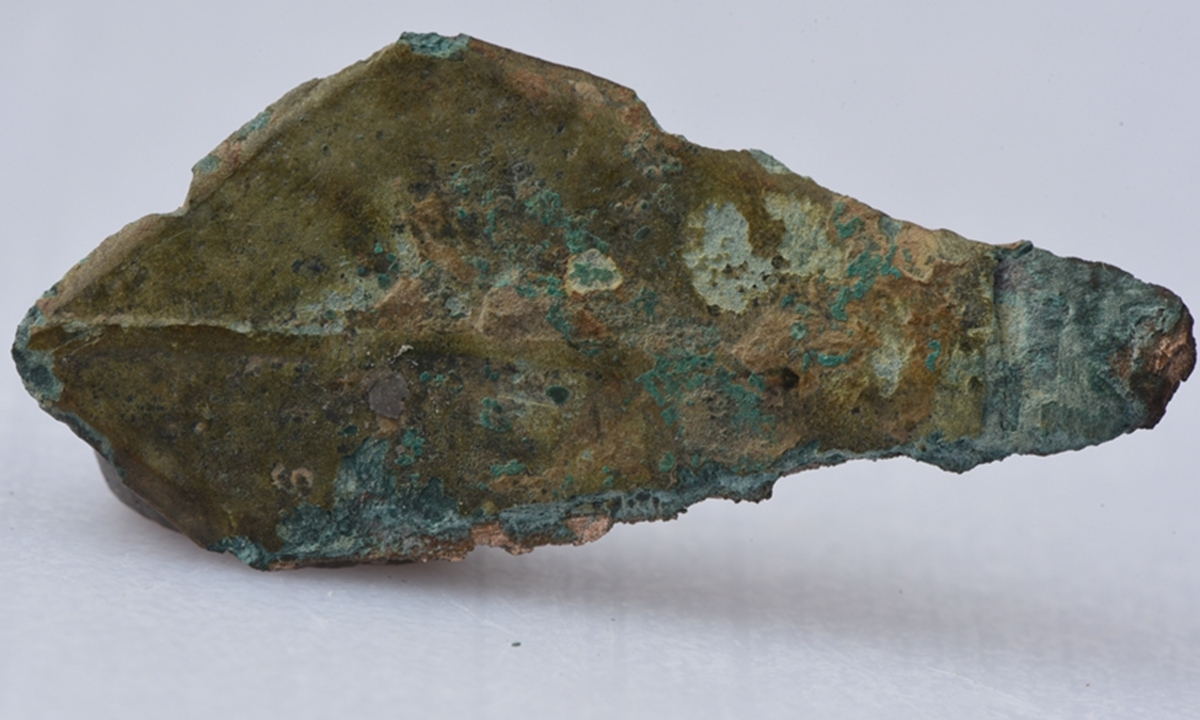
A recent archaeological discovery in China is challenging our understanding of ancient technology. Two small bronze artifacts found at the Gouwan site in Henan Province have been scientifically dated to be about 4,500 years old. This makes them the earliest known bronze objects ever discovered in the Yangtze River Basin.
The two artifacts were unearthed from layers of soil dating back to the late Qujialing culture. One is a 3.66-centimeter-long, arrowhead-shaped piece that closely resembles stone arrowheads from the same period. The other is a 6.45-centimeter-long, thin rod-shaped fragment. Examination revealed visible casting marks on both items, indicating they were man-made through an early metalworking process.
This finding is particularly significant because it challenges a long-held belief. Previously, most early bronze artifacts in China were found in the northwestern and northern regions. This led experts to assume that bronze technology in the Yangtze River Basin developed much later than in the Yellow River region. “These two bronze artifacts provide new materials for studying the origins of metallurgical (冶金的) technology,” said lead researcher Zhang Jian from Zhengzhou University. The discovery suggests that metallurgical experimentation in the middle Yangtze River area may have developed in parallel with the north, rather than simply being influenced by it.
1.1. What is the most groundbreaking aspect of the bronze artifacts?
A Their relatively small size.
B Their record-breaking age.
C Their uniquely shaped form.
D Their special burial site.
解析:选B。B 细节理解题。文章第一段明确指出:“Two small bronze artifacts... have been scientifically dated to be about 4,500 years old. This makes them the earliest known bronze objects ever discovered in the Yangtze River Basin.” 这些青铜器的最重要意义在于其年代打破了长江流域青铜技术发展晚于北方的传统观点,因此“破纪录的年代”是其最突破性的方面。其他选项(尺寸、形状、出土地点)虽在文中提及,但均非核心突破点。故选B。
2.2. What do we know about the making of the artifacts?
A They are naturally formed stones.
B They came into being naturally.
C They lacked any processing marks.
D They were cast by human beings.
解析:选D。D细节理解题。 第二段末尾提到:“Examination revealed visible casting marks on both items, indicating they were man-made through an early metalworking process.” 明确的铸造痕迹直接证明这两件文物是人工铸造的,否定了自然形成(选项B)或无加工痕迹(选项C)的可能性。故选D。
3.3. What was the previous academic view on China’s bronze technology?
A The Yangtze region’s development was later than the north’s.
B The two regions’ bronze tech developed simultaneously.The two regions’ bronze tech developed simultaneously.
C The southern bronze technology was more advanced.
D There was no early bronze in southern China.
解析:选A。A推理判断题。原文第三段对该观点有明确描述:“Previously... This led experts to assume that bronze technology in the Yangtze River Basin developed much later than in the Yellow River region”(此前,中国大多数早期青铜器发现于西北和北方地区,这使得专家们认为长江流域的青铜技术比黄河流域发展得晚得多)。B(两地同时发展)是本次发现得出的新结论,而非 “此前观点”;C(南方更先进)原文未提及,且与传统认知相悖;D(南方无早期青铜)过于绝对,原文仅说早期青铜器 “多发现于北方”,并非南方完全没有。故选A。
4.4. What is the main goal of the research team’s future work?
A To explore additional archaeological sites.
B To reconstruct ancient metalworking techniques.
C To investigate the sources of raw materials.
D To create exact replicas of the artifacts.
解析:选C。C 细节理解题。原文最后一段明确说明:“the research team plans to conduct further studies to trace the source of the minerals and better understand the technical development of early metalworking in this area”(研究团队计划开展进一步研究,以追踪矿物来源,并更好地了解该地区早期冶金技术的发展)。故选C。