
2025诺贝尔化学奖:解锁“魔法材料”的储气体奥秘
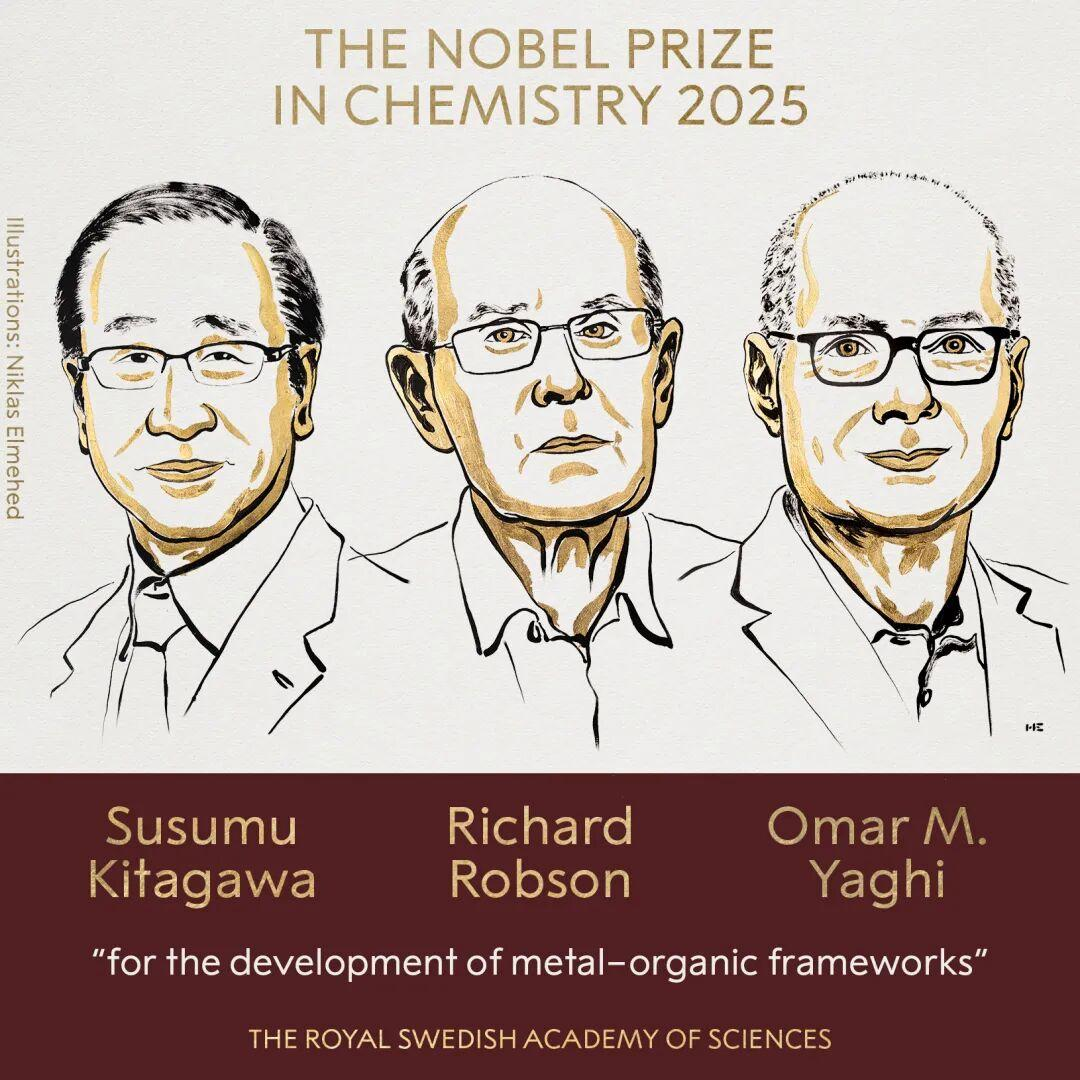
The 2025 Nobel Prize in Chemistry has been awarded to Susumu Kitagawa, Richard Robson, and Omar M. Yaghi for developing porous materials that can store and release gases like carbon dioxide. These materials are called metal-organic frameworks (MOFs). “A small amount of this material is almost like Hermione’s handbag in Harry Potter,” said Heiner Linke, chair of the Nobel Committee for Chemistry. “It can store huge amounts of gas in a tiny volume.”
Tens of thousands of different MOFs have now been created. They have many potential uses, from capturing CO₂ in chimneys to cleaning up harmful chemicals and collecting water from the air.
In the late 1980s, Richard Robson in Australia was inspired by the ordered structure of diamonds to create the first MOFs. He realized that metal ions (金属离子) could be used as connecting points, linked together by carbon-based molecules (分子). When mixed, these components form ordered frameworks by themselves. While the spaces in diamond are small, those in MOFs can be much larger. However, the spaces in Robson’s early MOFs were filled with water.
Susumu Kitagawa from Japan first created a framework stable enough to be dried, and successfully filled the empty spaces with gas. “He showed that gases could be taken in and also released from the material,” said Olof Ramström, a Nobel Committee member. Kitagawa also developed MOFs that change shape when gases are added or removed.
Omar M. Yaghi in the U.S. created even more stable frameworks using groups of metal ions containing zinc and oxygen, along with certain linking molecules. “This framework is amazing because it remains stable even at 300 degrees Celsius,” said Ramström. “But even more remarkable is its enormous surface area. Just a few grams of this porous material, about the size of a sugar cube, has a surface area as large as a football field.” Yaghi also showed that the spaces in MOFs can be enlarged simply by using longer linkers (连接分子).
After these important breakthroughs, the field developed very quickly. “We see new metal-organic frameworks created almost every day,” Ramström said.
1.1. According to the passage, what is the primary purpose of MOFs?
A To convert gases into solid.
B To contain gases effectively.
C To create tens of thousands of materials.
D To replace other substances.
解析:选B。B 细节理解题。第一段核心信息“for developing porous materials that can store and release gases”指出MOFs的主要功能是储存和释放气体,B选项“有效地容纳气体”准确概括了这一核心用途。故选B。
2.2. What potential benefit of MOFs is highlighted in the passage?
A Capturing CO₂ in chimneys.
B Purifying polluted air.
C Collecting water from the air.
D Changing water form.
解析:选B。B 推理判断题。第二段的“They have many potential uses, from capturing CO₂ in chimneys to cleaning up harmful chemicals and collecting water from the air.”介绍了MOFs的潜在应用,包括从烟囱捕获二氧化碳和清理有害化学品,这都属于“净化污染空气”的范畴。故选B。
3.3. What was the key limitation of Robson’s early MOFs?
A Too expensive to make.
B Too unstable to be dried.
C Spaces filled with water.
D Unable to form structures.
解析:选C。C 细节理解题。第三段末尾“However, the spaces in Robson’s early MOFs were filled with water.”明确指出罗布森早期MOFs的空隙充满了水,这是其关键局限性。故选C。
4.4. What makes Yaghi’s frameworks particularly remarkable according to the text?
A Extreme stability and large area.
B The ability to change shape.
C Beautiful color and shape.
D Simple making process.
解析:选A。A 细节理解题。第五段中的“it remains stable even at 300 degrees Celsius”“its enormous surface area”重点强调了Yaghi的框架具有极高的稳定性(耐300摄氏度高温)和巨大的比表面积,这是其最显著的特点。故选A。