
回归多元审美,伦敦时装周为 “不同身材” 发声
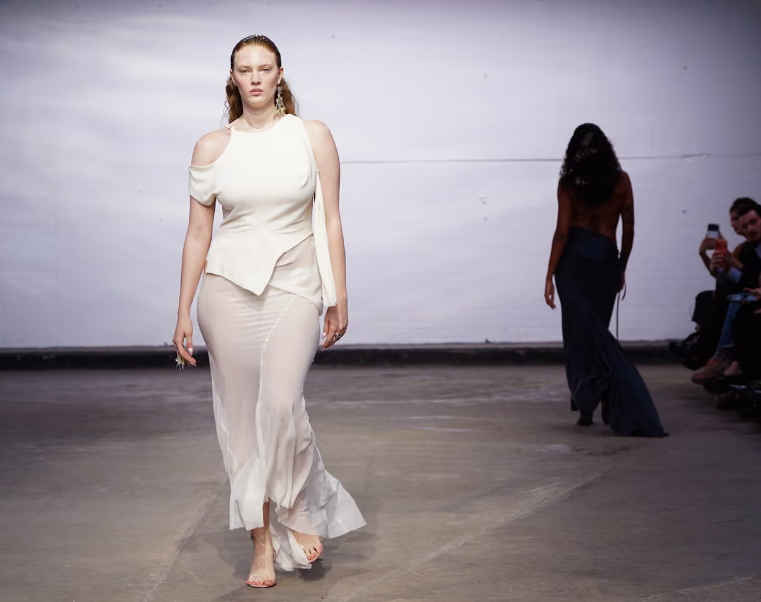
Recently, London Fashion Week witnessed a welcome return of body diversity on its catwalks, even as the wider fashion industry is shifting back towards celebrating ultra-thin models. Several emerging designers featured models of various shapes and sizes, ranging from UK size 10 to 16, often called “mid-size”, and plus-size models, from size 18 upwards. This move comes at a time when experts worry that past progress in size inclusivity is being reduced, with a troubling return to promoting thinness.
Karoline Vitto, a Brazilian designer based in London, was one of the voices calling for change. At her first catwalk show in two years, she questioned the disappearance of curve models. Her size-inclusive brand runs from a UK 8 to 22, and she chose models to match her clothing sizes. This way, the audience could truly see how the pieces would look on different bodies. As a new brand with a limited budget, many of her 23 diverse models even paid their own travel costs from places like Brazil and the US to support her idea.
Other designers also championed body diversity. Phoebe English used street casting to find more ordinary people with different body shapes. Sinead Gorey specially designed her clothes to praise and celebrate curves. In this way, they joined the effort to fight against the return of ultra-thin beauty ideals.
Casting directors note that while new designers are championing body diversity, the big luxury fashion houses need to lead by example. These major brands influence what is seen as acceptable and popular for younger labels. Unfortunately, there has been a recent decline in using plus-size models across the industry, partly influenced by a wider cultural shift towards thinness in Hollywood and other fields.
Despite this trend, Vitto remains hopeful. She believes inclusivity is not just a passing fashion but a serious promise for many designers, especially those led by women who understand the pressure to look a certain way. She points to other female-led, size-inclusive brands as pioneers of real change. For her, representing real bodies on the catwalk is not just a matter of fashion — it’s personal.
原创编写 版权所有 侵权必究 每日更新 个性化阅读 英语飙升1.1.What do experts think of the recent trend in the fashion industry?
A It’s a welcome return.
B It threatens past progress.
C It will end the use of thin models.
D It promotes body diversity.
解析:选B。B推理判断题。根据第一段最后一句“...experts worry that past progress in size inclusivity is being reduced...”(专家担心过去在尺码包容性上的进步正被削弱),可推断专家认为这一变化威胁到过去的成就。B项“It threatens past progress.”是对“being reduced”的同义转述。A 项与专家担忧的态度相反;C 项过于绝对,文中只说有回归趋势,并非终结;D 项是现象本身,而非专家的观点。故选B。
2.2.Why did Vitto choose models of different sizes?
A To cut the cost of her catwalk show.
B To attract models from abroad.
C To match her clothing range.
D To expand her brand size.
解析:选C。C细节理解题。根据第二段的“Her size-inclusive brand runs from a UK 8 to 22, and she chose models to match her clothing sizes.”可知,她选择了与她服装尺码范围相匹配的模特,目的是为了与自己品牌的服装尺码范围相匹配。C项 to match her clothing range 精准概括了这一点。故选C。
3.3.Why are Phoebe English and Sinead Gorey mentioned?
A To list more supporters of body diversity.
B To show their own special clothing styles.
C To introduce ways of finding ordinary models.
D To prove the popularity of their new brands.
解析:选A。A推理判断题。第三段的主题句是“Other designers also championed body diversity.”,因此提及这两位设计师Phoebe English 和 Sinead Gorey是为了举例说明更多设计师支持身材多样性。故选A。
4.4.What do casting directors expect of major luxury brands?
A To follow the latest trend.
B To play a leading role.
C To learn from younger designers.
D To stop using plus-size models.
解析:选B。B细节理解题。根据第四段的“…the big luxury fashion houses need to lead by example.”可知,选角导演希望大型奢侈品牌能以身作则,树立好榜样。故选B。