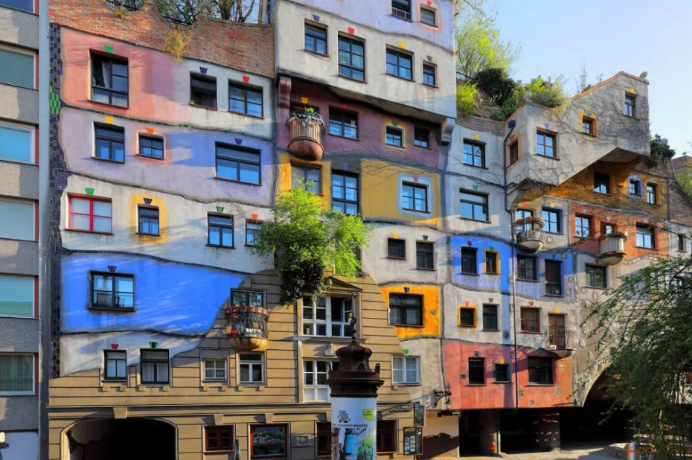
Friedensreich Hundertwasser, an Austrian-born artist, held a deep dislike for straight lines. In his view, straight lines were “immoral”: in them lived no human spirit, only a manufactured, mindless mass addicted to comfort. This strong opinion is clearly reflected in his architectural works, which are filled with unexpected curves, lively colors, and imaginative shapes.
Born in 1928, Hundertwasser first made his name as a painter. He was known for his natural, spiral-like forms and bright colors. It was not until the 1970s that he started to explore architecture. Unlike the strict and often impersonal style of Brutalism, Hundertwasser preferred irregularity — a quality he saw in nature. He believed that modern architecture was lifeless and failed to meet human needs. “In our modern functional buildings, the human spirit is suffering,” he once said. “We are moving toward architecture that is impractical and even unfit to live in.”
By the 1980s, Hundertwasser began to take action. He called himself an “architecture doctor,” treating buildings that harmed the visual environment. In 1986, he completed the Hundertwasserhaus in Vienna. This apartment building features uneven floors, a roof covered with grass and soil, and trees growing inside. Its colorful outer walls and unusual shapes make it stand out. Hundertwasser designed the building without payment, hoping to prevent something ugly from being built in its place.
Another example is the Waldspirale in Germany, built in the 1990s. This U-shaped building has a green roof filled with plants and trees. Its outer walls are decorated with earth-colored lines. The structure is topped with golden domes, and what makes it special is that all 1,000 windows are different from one another. Even the door handles in each apartment are unique.
Hundertwasser’s final project, the Maishima Incineration Plant in Japan, was completed in 2001, a year after his death. The building has a golden dome chimney, colorful tiles, and over 500 windows, though only 130 are real. Throughout his life, Hundertwasser created more than 40 buildings worldwide. Each one challenges traditional design and stands as a symbol of his creative and boundless imagination.
原创编写 版权所有 侵权必究 每日更新 个性化阅读 英语飙升
1.1. According to Hundertwasser, straight lines are considered ______.
A a sign of high morality
B a symbol of progress
C lacking in human spirit
D the only way to create
解析:选C。1.C细节理解题。根据第一段,Hundertwasser认为直线是“immoral”,因为“in them lived no human spirit”,选项C“lacking in human spirit”正是对原文的同义替换。故选C。
2.2. What is the main idea of the second paragraph?
A Hundertwasser’s painting career.
B Hundertwasser’s admiration for Brutalism.
C Brutalism’s influence on Hundertwasser’s style.
D Hundertwasser’s architectural philosophy.
解析:选D。2.D段落大意题。第二段以百水先生最初以画家身份成名为切入点,随后交代他直到20世纪70年代才开始探索建筑领域,并通过他对现代建筑的批判(认为其“毫无生气”、无法满足人类精神需求),重点引出并阐述其核心建筑理念——崇尚自然的不规则形态、关注人的精神需求。整段核心是阐述百水先生的建筑理念。故选D。
3.3. Why does the author mention the Hundertwasser’s Hundertwasserhaus in Vienna?
A To show his style was put into practice.
B To prove Vienna has many great buildings.
C To suggest his work had little influence.
D To show his skills as a medical doctor.
解析:选A。3.A推理判断题。第三段描述Hundertwasserhaus的具体特征(不平坦的地板、屋顶覆土、树木生长等),这些特征正是他反对直线、崇尚曲线与自然理念的体现,作者提及此建筑是为了证明其设计理念得到了实际应用。故选A。
4.4. What makes the Waldspirale in Germany unique?
A Its golden domes.
B Its winding paths.
C Its rare U-shape design.
D Its one thousand windows.
解析:选D。4.D细节理解题。第四段明确写道:“what makes it special is that all 1,000 windows are different from one another”,强调其特别之处在于一千扇各不相同的窗户,选项D是对这一核心特征的概括。故选D。
