
百年前那辆“世界最平稳”的八轮汽车,为何惨败?
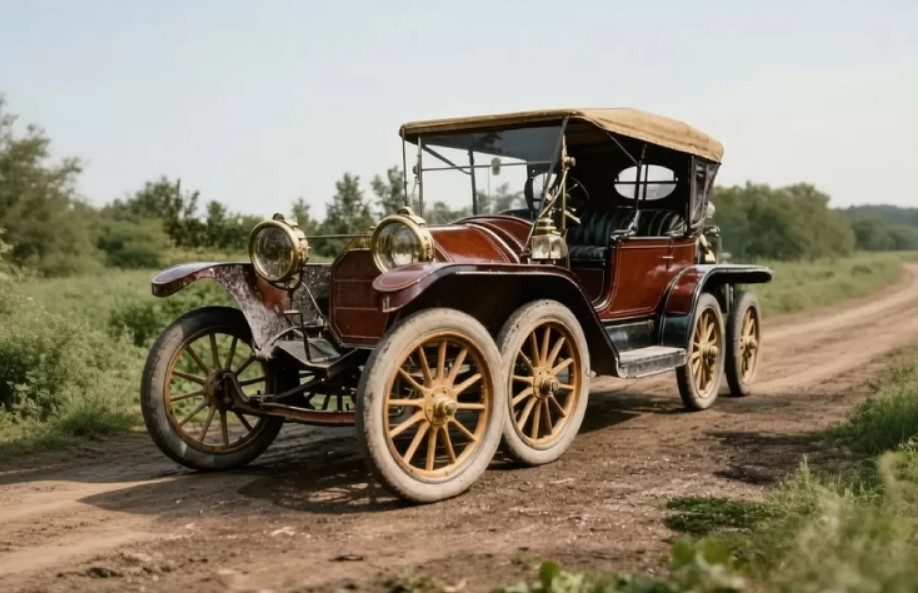
Car suspension systems have come a long way. While modern drivers may complain about rough roads, the situation was far worse in the early 1900s. Back then, inventors were already exploring unusual ways to make journeys less painful. One of the most striking results of that effort was the eight-wheeled Octoauto.
The Reeves Overland Octoauto, created by Milton Reeves in 1911, remains one of the strangest automobiles in history. It was designed to address a major problem of the time: ride comfort. Early cars lacked effective suspension, and the constant shocks not only troubled passengers but also destroyed tires at an alarming rate.
Inspired by railway carriages — which spread their load over several separate wheel sets to ease the journey — Reeves wondered if the same principle could work on the road. The key to the Octoauto was that it rested on eight wheels arranged in four pairs. Both pairs up front could be turned to steer, while the two pairs at the back helped carry the weight, though only the forward pair of the back wheels actually drove the car. Reeves was convinced that spreading the car’s weight so evenly would take pressure off the tires and the springs, promising passengers a much gentler ride.
Marketing materials proudly called it “the smoothest-riding car in the world.” When it was displayed at the very first Indianapolis 500 race in 1911, the Octoauto caused a great stir, attracting as much attention as the racing machines themselves. Crowds were curious about its bold design and promise of extreme comfort.
Unfortunately, curiosity did not lead to sales. The Octoauto was perhaps too daring even for the experimental early automobile era. With a price tag of $3,200 — roughly four times the cost of a Ford Model T — it was out of reach for most buyers. Moreover, the complex multi-axle setup made the car difficult to handle. Although Reeves later tried to correct this with a six-wheeled version called the Sextoauto, the market had already turned toward simpler, cheaper options.
Today, the Reeves Octoauto is remembered not as a commercial success, but as a fascinating example of thinking outside the box — a bizarre yet brilliant footnote in the history of transportation.
原创编写 版权所有 侵权必究 每日更新 个性化阅读 英语飙升1.1. What was a major drawback of early 20th-century automobiles?
A High fuel cost.
B Short tire life.
C Low passenger capacity.
D Slow engine response.
解析:选B。B细节理解题。文章第一段提到“早期的汽车缺乏有效的悬挂系统,持续的震动不仅困扰乘客,还以惊人的速度损坏轮胎”,其中“destroyed tires at an alarming rate”直接对应选项B中的“Short tire life”(轮胎寿命短)。选项A“高燃料成本”、选项C“低乘客容量”和选项D“发动机响应慢”在文中均未提及,因此排除。故选B。
2.2. What was special about the Octoauto’s driving system?
A All wheels provided power.
B Part of the rear wheels drove.
C Front wheels powered it.
D Each wheel worked separately.
解析:选B。B细节理解题。文章第三段明确描述了其轮子布局和驱动方式:“只有后轮中靠前的那一对轮子实际上驱动汽车”(though only the forward pair of the back wheels actually drove the car)。这直接对应选项B“部分后轮提供驱动力”。选项A“所有轮子都提供动力”与原文矛盾;选项C“前轮驱动”错误;选项D“每个轮子独立工作”文中未体现。故选B。
3.3. Why does the author mention the Ford Model T in Paragraph 5?
A To show the Octoauto’s high price.
B To praise Ford’s low cost.
C To compare two car designs.
D To criticize early car quality.
解析:选A。A推理判断题。第五段中作者写道“With a price tag of $3,200 — roughly four times the cost of a Ford Model T”,通过将Octoauto售价与福特T型车进行价格倍数对比,意在突出其定价之高,从而解释销售失败的经济原因。A项“To show Octoauto’s high price”准确概括了此处的写作意图。B项偏离核心论点;C项原文未比较设计;D项无中生有。故选A。
4.4. What is the author’s tone when concluding the story of the Octoauto?
A Critical but hopeful.
B Neutral and indifferent.
C Regretful for its business loss.
D Appreciative of its creativity.
解析:选D。D观点态度题。文章最后一段将其定性为“商业上的失败”,但紧接着用“fascinating example of thinking outside the box”(跳出常规思维的迷人范例)和“bizarre yet brilliant footnote”(怪异但精彩的历史注脚)来评价它。这种用词表明作者虽然承认其失败,但对其大胆的创造力和设计思路持有明显的赞赏态度,因此选项D“对其创造力的欣赏”最为准确。选项A“批判但抱有希望”中的“批判”不准确;选项B“中立冷漠”与结尾的积极评价矛盾;选项C“为其商业损失惋惜”虽略有情感,但不如“欣赏其创造力”来得准确和全面,且“brilliant”一词更侧重正面肯定。故选D。