
18岁高中生“炼”出净水黑科技,微塑料去除率超95%
A few years ago, teenager Mia Heller came across an article in her local newspaper about water quality issues in her neighborhood in Warrington, Virginia. Tests had shown that the local drinking water was highly contaminated. It contained harmful substances like PFAS and microplastics. The article also reported that government agencies would not provide funds for filtering the water. “It was up to people to provide their own filtration (过滤),” says Heller.
Not long after, Heller’s parents bought an advanced water filtration system for their home. However, the system required constant upkeep. Watching her mother replace the water filter membranes (膜) time and again, Heller set out to find a better solution. “It inspired me to design a filter without the use of membranes, to decrease the costs and maintenance needs associated with water filtration,” says the now 18-year-old student at Kettle Run High School.
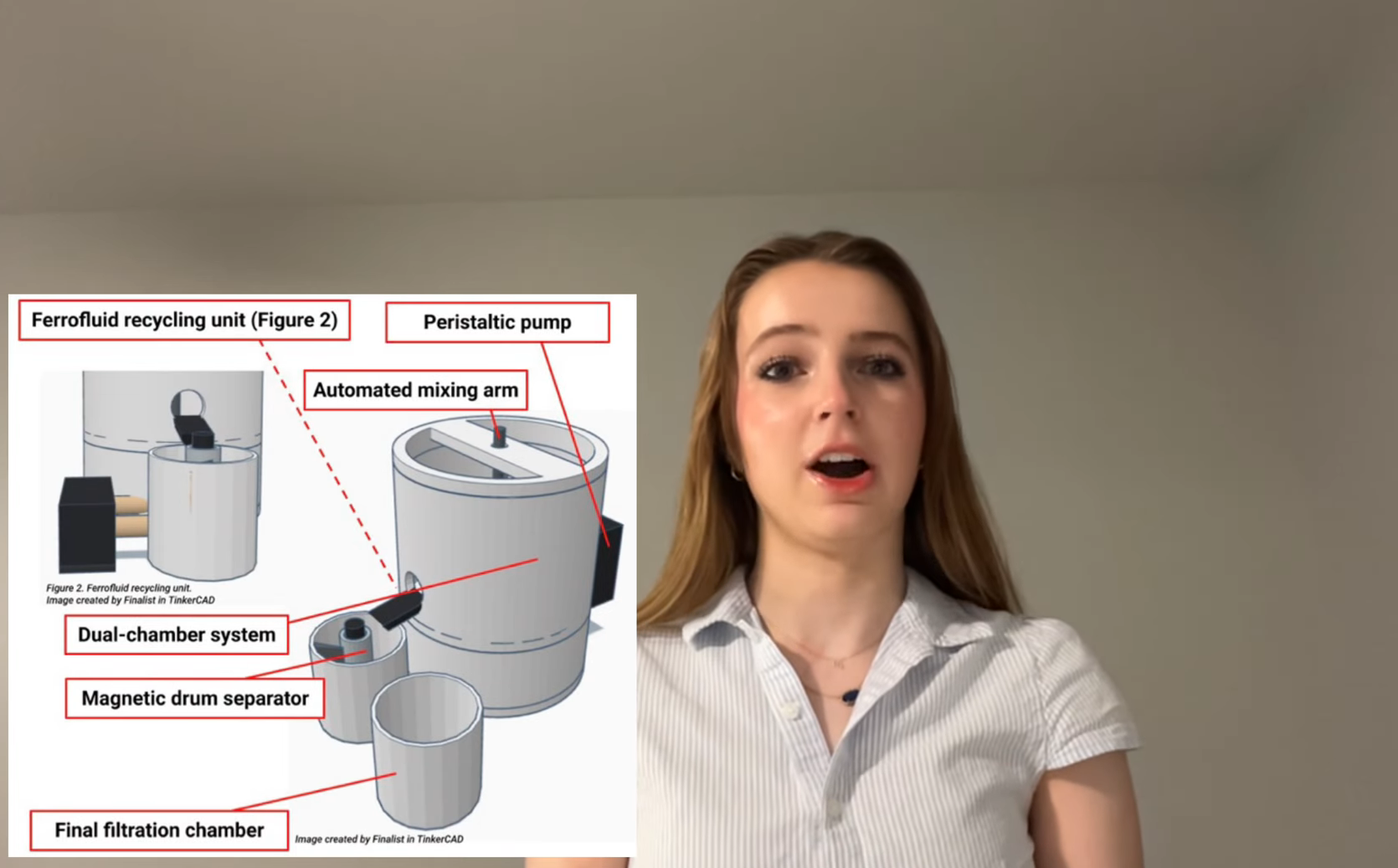
In the spring of 2024, Heller had the idea for her filtration system, and she really got working on it in the summer of 2024. By early January of 2025, after experimenting in her garage and kitchen, she had a working prototype. Her current system consists of three modules and uses a reusable magnetic oil called ferrofluid to selectively bind to microplastic particles. A magnetic field pulls the microplastics out of the water, and the ferrofluid is recovered and reused in a closed loop system.
To test the accuracy of her device, Heller developed a turbidity (浊度) sensor to measure the amount of suspended solids. According to her tests, the prototype successfully removed 95.52 percent of microplastics from the water and recycled 87.15 percent of the ferrofluid. By comparison, traditional drinking-water treatment plants remove about 70 to more than 90 percent of microplastic components. “The result is an affordable, low-waste filtration system without the use of a solid membrane,” says Heller.
Her innovation has earned her recognition. She was a finalist in the 2025 Regeneron International Science and Engineering Fair and received a special award for her technology. While she sees the system as suitable for individual home use, she plans to verify her results professionally and eventually bring it to market.
1.1. What does the word “contaminated” in Paragraph 1 most probably mean?
A Purified.
B Polluted.
C Examined.
D Improved.
解析:选B。B词义猜测题。第一段提到水被检测出含有PFAS和微塑料等“harmful substances”(有害物质),且政府不提供过滤资金,居民需自行解决。这一语境明确指向水质出现了安全问题。因此“contaminated”意为受污染的,对应选项B(Polluted)。选项A(Purified,净化)和选项D(Improved,改善)与有害物质存在的逻辑相悖;选项C(Examined,检测)虽与后文测试有关联,但句子描述的是检测“结果”显示水已“高度被……”,填入“检测”语义不通顺,故不选。故选B。
2.2. Why did Heller decide to design a new water filter?
A The government refused to offer help.
B Her mother asked her to solve the problem.
C The old filter needed constant care.
D The newspaper called on teens to take action.
解析:选C。C细节理解题。答案依据在第二段:“the system required constant upkeep. Watching her mother replace the water filter membranes time and again, Heller set out to find a better solution.” 这说明她看到母亲需要不断更换滤膜,维护繁琐,才萌生了设计无膜滤水器的想法,对应选项C(旧滤水器需要持续维护)。选项A(政府拒绝帮助)虽是背景事实,但并非促使她动手设计的直接诱因;选项B(母亲要求她解决问题)属于无中生有,文中未提及母亲提出要求;选项D(报纸号召青少年行动)在文中也未出现。故选C。
3.3. How does Heller’s prototype remove microplastics?
A By using solid membranes to trap them.
B By chemically treating the polluted water.
C By employing magnetic oil to attract them.
D By replacing its key parts more frequently.
解析:选C。C细节理解题。第三段明确说明其系统“uses a reusable magnetic oil called ferrofluid to selectively bind to microplastic particles”,即利用一种可重复使用的磁性油(铁磁流体)选择性地结合微塑料颗粒,再用磁场将其拉出。这完全符合选项C的描述(通过使用磁性油来吸引微塑料)。选项A(使用固体膜捕获)恰恰是Heller想要摒弃的传统方法;选项B(化学处理污水)文中未提及化学反应;选项D(更频繁更换核心部件)与设计初衷“decrease maintenance needs”相悖。故选C。
4.4. What does the comparison in Paragraph 4 suggest?
A Heller’s device works better than traditional ones.
B Heller’s device costs far less than common systems.
C Heller’s device is fit for large industrial factories.
D Heller’s device has been put into market widely.
解析:选A。A推理判断题。第四段指出Heller的设备去除了95.52%的微塑料,而传统水处理厂去除率在70%到90%多不等。通过具体数字对比,意在暗示Heller设计的过滤效率不仅不逊色,甚至优于许多传统大型设备,从而突显其有效性。因此选项A(Heller的设备比传统设备表现更好)是合理推断。选项B(成本远低于普通系统)虽可能成立,但本段数据对比的是去除率而非成本;选项C(适合大型工厂)与后文“for individual home use”矛盾;选项D(已广泛上市)与最后一句“eventually bring it to market”的将来时态不符。故选A。