
百年前的悬架狂想:这款八轮汽车曾轰动印地500大赛
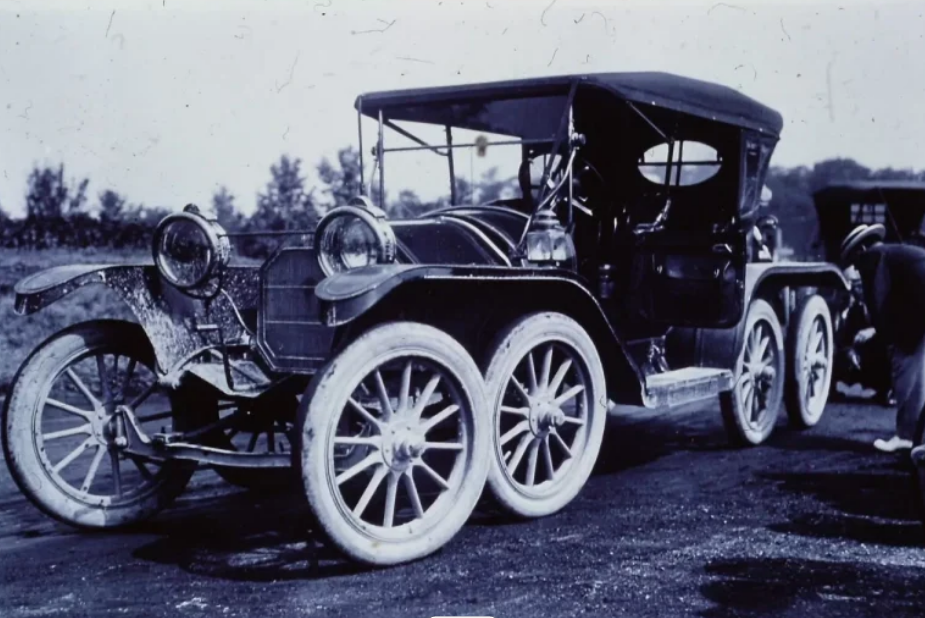
Car suspension (悬架) has not always been as efficient as it is today. Although modern roads may still feel far from perfect, they were in far worse condition during the early 1900s. Yet even in that era, engineers and inventors came up with creative and unusual ideas to improve passenger comfort. Among these strange yet fascinating inventions was the eight-wheel Reeves Overland Octoauto.
Designed by American inventor Milton Reeves in 1911, the Octoauto was created to solve a critical problem of the age: uncomfortable rides. Early cars provided an extremely bumpy (颠簸的) experience, and their weak suspension systems also caused rapid and excessive tire wear. Seeking inspiration from railway design, Reeves wondered if adding more wheels to a car could achieve the same smoothness as train carriages, which used multiple bogies (转向架) to spread weight and reduce vibration.
Its most distinctive feature was the four-axle (轮轴), eight-wheel structure. The front end had two steerable axles, while the rear contained another two, with only the first rear axle providing power. Reeves believed that more even weight distribution would lower stress on wheels and suspension, delivering a smoother ride and slower tire damage. Advertisements proudly described it as “the smoothest-riding car in the world.”
The car made its first public appearance at the 1922 Indianapolis 500, creating an immediate sensation and attracting nearly as much attention as the racing vehicles. However, public interest did not lead to actual sales. Priced at $3,200 — roughly equivalent to four Ford Model Ts or two Cadillac Model 30s — it was far too expensive. Its complex multi-axle design also resulted in poor handling. Although Reeves later introduced the six-wheel Sextoauto to fix these issues, consumers preferred more affordable alternatives.
1.1.What does the author indicate about early cars in the 1900s?
A They ran at high speed.
B They offered poor comfort.
C They had a short lifespan.
D They paid attention to safety.
解析:选B。B推理判断题。文章第一段提到 “modern roads may still feel far from perfect, they were in far worse condition during the early 1900s”,第二段又指出 “Early cars provided an extremely bumpy experience”,说明 20 世纪初的汽车行驶非常颠簸,乘坐舒适度很差。A 选项 “高速行驶”、C 选项 “寿命短”、D 选项 “注重安全” 在文中均无相关信息支撑,因此排除。故选B。
2.2. Why did Milton Reeves equip the car with multiple axles?
A To reduce uneven shaking.
B To follow railway standards.
C To make steering easier.
D To increase carrying capacity.
解析:选A。A细节理解题。第二段明确提到 “Reeves wondered if adding more wheels to a car could achieve the same smoothness as train carriages... reduce vibration”,他增加车轮是为了像火车一样减少震动,提升行驶平稳性。B 选项 “遵循铁路标准” 错误,他只是借鉴火车设计思路而非遵守标准;C 选项 “让转向更轻松”、D 选项 “增加承载能力” 文中未提及,故排除。故选A。
3.3. How did the eight-wheel design work?
A It slowed down the car speed.
B It reduced the number of wheels.
C It spread the weight evenly.
D It increased the stress of the tires.
解析:选C。C细节理解题。第三段直接说明 “Reeves believed that more even weight distribution would lower stress on wheels and suspension”,八轮设计的核心作用是让重量分布更均匀。A 选项 “降低车速”、B 选项 “减少车轮数量” 与原文相悖;D 选项 “增加轮胎压力” 错误,原文是降低压力,因此排除。故选C。
4.4. Why did the Octoauto fail commercially?
A It was too costly.
B It looked unattractive.
C It had no public attention.
D It couldn’t be mass-produced.
解析:选A。A细节理解题。第四段指出 “Priced at $3,200 — roughly equivalent to four Ford Model Ts or two Cadillac Model 30s — it was far too expensive.”其售价为 3200 美元——大约相当于四辆福特T型车或两辆凯迪拉克30型车的价格——但这个价格实在是太高了。价格过高是 Octoauto 商业失败的主要原因。B 选项 “外观不吸引人” 错误,它曾引起巨大轰动;C 选项 “没有公众关注” 与原文 “creating an immediate sensation” 矛盾;D 选项 “无法批量生产” 文中未提及,故排除。故选A。