
中轴线天坛耸峙,琉璃顶祈年殿恢弘
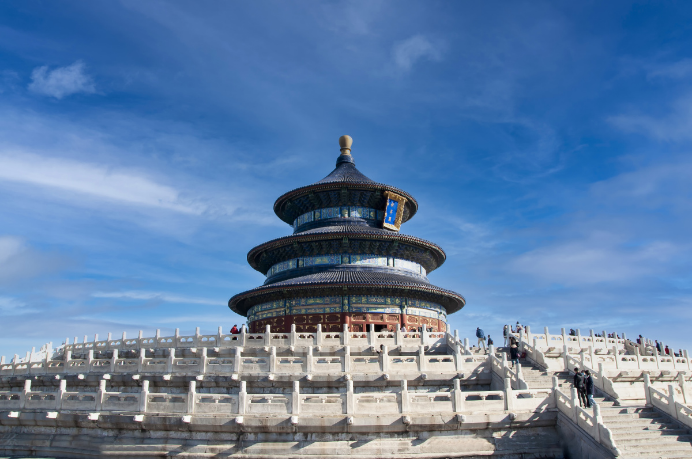
The Temple of Heaven, or Tiantan, is a famous symbol of Beijing. Its image appears everywhere — on metro cards, bank signs, hotels, etc. First built in 1420 when Emperor Yongle moved the capital to Beijing, this grand ceremonial complex (祭祀建筑群) has stood for over 600 years. After many careful repairs, it now stands beautifully along Beijing’s Central Axis, reflecting the ideal order of the ancient Chinese capital.
1.1. What can we NOT know about The Temple of Heaven from Paragraph 1?
A Its building time.
B Its location.
C Its main use.
D Its building style.
解析:选D。D细节理解题。第一段提到天坛1420年建成(对应A选项建造时间)、位于北京中轴线(对应B选项地理位置)、是大型祭祀建筑群(对应C选项主要用途),但全文第一段没有提及建筑风格,因此无法从第一段得知其建筑风格,故选D。
2.2. What does the underlined word “It” refer to?
A The Altar for Grain.
B The three-layer roof.
C The golden top.
D The Qiniandian Hall.
解析:选D。D词意指代题。划线词It该段核心句为“The most important building is the Hall of Prayer for Good Harvests, also called Qiniandian.”后文紧接着介绍这座圆形建筑的屋顶、功能等特征,因此It指代前文的祈年殿(Qiniandian Hall)。A谷物祭坛范围更大;B三层屋顶、C金顶都只是建筑局部,不能作指代对象,故选D。
3.3. What does the middle twelve pillars represent?
A Twelve animals.
B Twelve hours.
C Twelve months.
D Twelve stars.
解析:选C。C细节理解题。文中明确原文“The middle twelve represent the twelve months.”直接说明中间十二根柱子代表十二个月。A十二生肖、B十二时辰、D十二星辰均与原文表述不符,故选C。
4.4. The building shows that ancient Chinese people were good at ______.
A stars and building
B farming and fishing
C painting and music
D poems and stories
解析:选A。A推理判断题。文章介绍祈年殿精妙的木质立柱建筑结构,体现古人建筑技艺;又提到二十八根柱子对应古代天文学二十八星宿、二十四节气等天文知识,体现古人天文星宿认知。B农耕捕鱼、C绘画音乐、D诗歌故事在文中均无相关依据,故选A。
5.5. Where can we most probably read this passage?
A In a travel magazine.
B In a storybook.
C In a weather report.
D In a sports newspaper.
解析:选A。A推理判断题。文章介绍了天坛的历史、建筑特色、文化寓意和历史作用,属于人文景点介绍类内容,最有可能出现在旅游杂志上。B故事书以叙事故事为主;C天气预报、D体育报纸和文章内容完全无关。故选A。