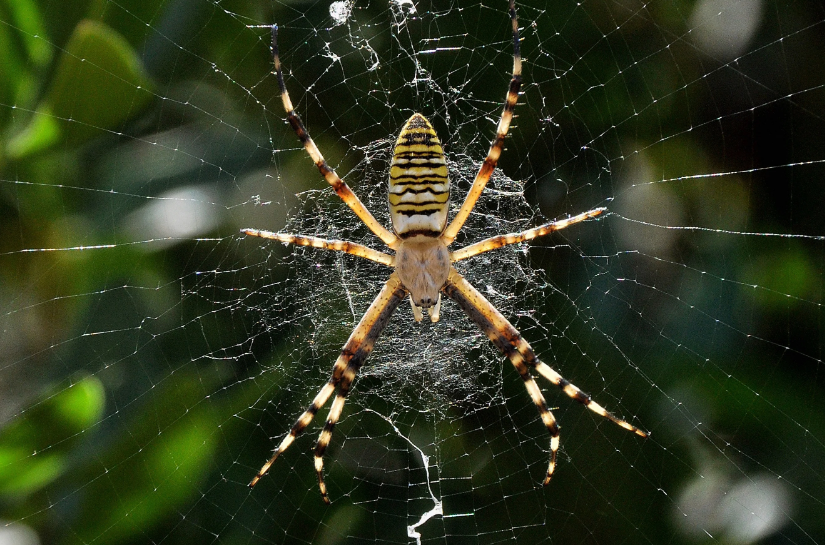
Many people feel afraid or disgusted when they see spiders, scorpions, or harvestmen. However, these arachnids (蛛形纲动物), together with insects, play a vital role in keeping our ecosystems healthy. As global biodiversity declines and some scientists warn of an “insect apocalypse”, two ecologists decided to study how these often-ignored animals are doing. Their research, recently published in a scientific journal, found huge gaps in our knowledge.
“Insects and arachnids are basic to human society,” says Laura Figueroa, the study’s senior author. “They pollinate plants, control pests and help monitor air and water quality. While animals like lions and pandas receive international conservation attention, insects and arachnids are largely overlooked. We wanted to know how they were truly doing.”
Figueroa and her graduate student Wes Walsh examined the conservation status of all 99,312 known insect and arachnid species in North America. The results were alarming: nearly 90% (88.5% to be exact) have no conservation status. “We simply don’t know how they are doing,” says Figueroa. Most of the available data focuses on water insects that help check water quality, or on colorful groups such as butterflies and dragonflies. “Arachnids are especially ignored; most U.S. states protect zero spider species,” Walsh adds. The researchers also found that states depending heavily on mining and oil protect fewer species, while environmentally-minded states protect more.
To improve protection, Figueroa points to bird conservation as a model. “The best results happen when diverse groups — hunters, bird watchers, nonprofits — work together,” she says. “If we can form similar broad partnerships for insects and arachnids, they too can receive the protection they need.”
Walsh stresses that these creatures are more than objects of fear. “We need to appreciate their ecological importance, collect more data and consider them worthy of conservation.” Protecting these tiny but vital animals is an essential step toward a healthier planet.
原创编写 版权所有 侵权必究 每日更新 个性化阅读 英语飙升
1.1.The underlined phrase “insect apocalypse” probably means ______.
A insect evolution
B insect discovery
C insect extinction
D insect migration
解析:选C。C 词义猜测题。定位原文第一段“As global biodiversity declines and some scientists warn of an ‘insect apocalypse,’ two ecologists decided to study how these often-ignored animals are doing.”,由前文全球生物多样性下降这一关键线索,可推断该短语表示昆虫大量消亡,A昆虫进化、B昆虫发现、D昆虫迁徙均不符合语境。故选C。
2.2.What conclusion can be drawn from the study?
A Many spiders are well protected.
B All species are well studied.
C Butterflies are disappearing fastest.
D Protection is urgently needed.
解析:选D。D 推理判断题。研究结果显示北美近90%的已知昆虫和蛛形纲物种缺乏保护状态评估,蛛形纲尤甚,多数州保护的蜘蛛物种数为零。综合这些发现可以合理推断,这些生物正面临严重的保护缺口,保护行动已刻不容缓。A项与文中“most states protect zero spider species”直接矛盾;B项错在“all species”,原文明确说存在巨大知识空白;C项中的“disappearing fastest”属无依据的比较,文章仅提到数据集中于蝴蝶等类群,并未提及其消失速度最快。因此D项是最符合研究结论的推论。
3.3.What does Figueroa want to express in Paragraph 4?
A Bird conservation isn’t a good model.
B Mining and oil help protect insects.
C Cooperation brings better protection.
D Scientists should work alone.
解析:选C。C 推理判断题。第四段中,Figueroa以鸟类保护为成功范例,强调当猎人、观鸟人士和非营利组织等多元群体通力合作时,保护效果最佳,并主张为昆虫和蛛形纲建立类似的广泛伙伴关系。可见她意在表达协作能带来更好的保护成效。A项与“bird conservation as a model”完全相反;B项歪曲了第三段中依赖采矿和石油的州保护物种更少的事实;D项“科学家应独自工作”与合作共赢的理念背道而驰,故C项正确。
4.4.What is the best title for the passage?
A The Overlooked Tiny Ecological Helpers Need Protection
B Insects and Arachnids Bring People Fear and Disgust
C Bird Conservation: A Successful Model for Environmental Work
D Global Biodiversity Is Facing a Severe Crisis
解析:选A。A 主旨大意题。文章开篇介绍昆虫与蛛形纲对生态意义重大却常被人们嫌弃忽视,中间用调研数据说明多数物种缺少保护,文末呼吁多方协作加以保护,B只截取开头人们惧怕小虫的细节、C鸟类保护只是举例参照、D生物多样性危机仅为写作背景,三项都不能概括全文,只有A完整概括文章核心内容。故选A。
