
口袋公园:“绣”出城市方寸之美
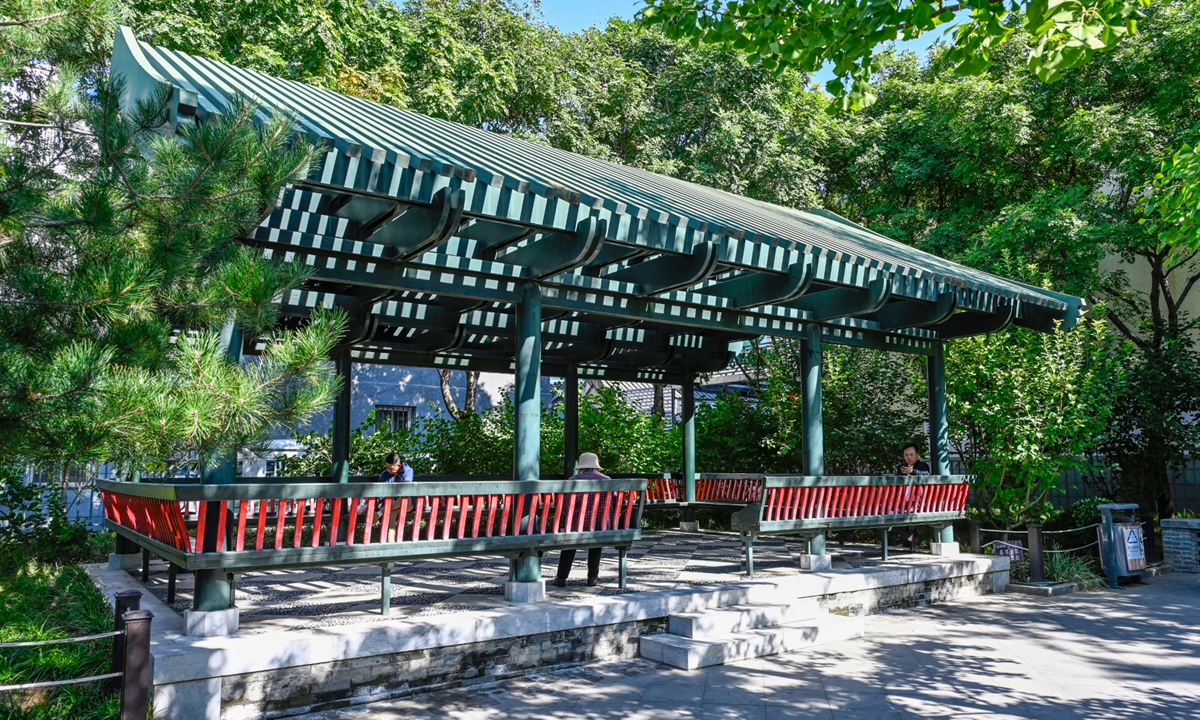
Near Beijing’s busy Shichahai scenic area, a peaceful pocket park stands where messy illegal structures once occupied the site. Nowadays, local elderly residents often gather here to play Chinese chess, surrounded by blooming Chinese roses that soften the noise of the bustling city. This lovely mini park is not unique. It is one of thousands of pocket parks that are transforming China’s urban landscapes and ordinary people’s daily lives across the country.
Also called mini parks, pocket parks are usually small, often smaller than a standard football field. Built on idle urban land, vacant roadside spaces or sites once occupied by illegal buildings, they are fitted with basic facilities like shaded walkways and leisure benches. These tiny green oases (绿洲) scattered in residential communities serve diverse groups. Seniors practice tai chi for relaxation, little kids play freely, and busy office workers can take a short break to refresh themselves on workdays.
Official data shows the rapid development of such urban upgrades. Over China’s 14th Five-Year Plan period, more than 18,000 pocket parks were built nationwide. Urban experts point out that this trend marks a key shift in China’s urban renewal. The city renovation (翻新) model has changed from large-scale, top-down projects to a people-centered and refined renewal. Instead of pulling down old neighborhoods for huge constructions, cities now focus on making full use of abandoned land at low cost to improve urban livability.
1.1.What do we know about the pocket park near Shichahai?
A It lies in remote areas.
B It has a transformed environment.
C It is a one-of-a-kind site.
D It suffers from heavy noise.
解析:选B。B细节理解题。根据第一段描述,什刹海附近的口袋公园所在地原本是杂乱无章的违章建筑,如今变成了和平宁静、有玫瑰环绕的小公园,可见它的环境经过了彻底改造,因此B项“它有一个改造后的环境”正确。A项错误,因为原文明确指出该公园靠近繁忙的什刹海景区,并非位于偏远地区;C项错误,文章紧接着说“This lovely mini park is not unique”,表明它并非独一无二;D项错误,文中提到盛开的玫瑰“soften the noise of the bustling city”,即缓和了城市的喧嚣,而不是说它遭受严重的噪音困扰。故选B。
2.2. What can we know about pocket parks from Paragraph 2?
A They have large land areas.
B They own high-class facilities.
C They target working people.
D They serve various residents.
解析:选D。D细节理解题。第二段最后一句明确说明口袋公园服务于多样群体,包括打太极的老年人、自由玩耍的幼儿和在工作日短暂休息的上班族,因此D项“它们服务各类居民”正确。A项与原文直接冲突,文中说口袋公园通常很小,往往比标准足球场还小;B项错误,第二段提到它们配备的是遮阳小路和休闲长椅等基本设施,并非高档设施;C项以偏概全,上班族只是口袋公园所服务的群体之一,并非唯一目标人群。故选D。
3.3. What’s the advantage of China’s new urban renovation model?
A It is low-cost and effective.
B It needs large-scale projects.
C It rebuilds old neighborhoods.
D It wastes urban land.
解析:选A。A细节理解题。第三段指出中国城市翻新模式已从大规模、自上而下的项目转向以人为本的精细化更新,如今城市专注于低成本充分利用废弃土地,以提升宜居性,由此可知新模式的优势正是低成本且富有成效,故A项正确。B项“它需要大规模项目”与新模式背道而驰,那是被替代的旧模式;C项“它重建老旧社区”同样属于旧模式中“推倒旧社区进行大建设”的做法;D项“它浪费城市土地”与原文相反,新模式恰恰是对废弃土地的再利用。故选A。
4.4. What’s the author’s attitude towards pocket parks?
A Doubtful.
B Critical.
C Positive.
D Uncertain.
解析:选C。C观点态度题。作者在介绍口袋公园时,通篇使用积极正面的描述,如将其称为“小小的绿色绿洲”,强调它们带来的生态效益、文化传承功能,并在结尾总结时赞许其“完美展现了中国以人为本和可持续的城市发展智慧”,由此可见作者的态度是明确肯定和赞赏的,故选C项“积极的”。A项“怀疑的”、B项“批评的”和D项“不确定的”均与文中透露的情感基调完全不符。故选C。