
传说与真实:解读魔鬼桥故事
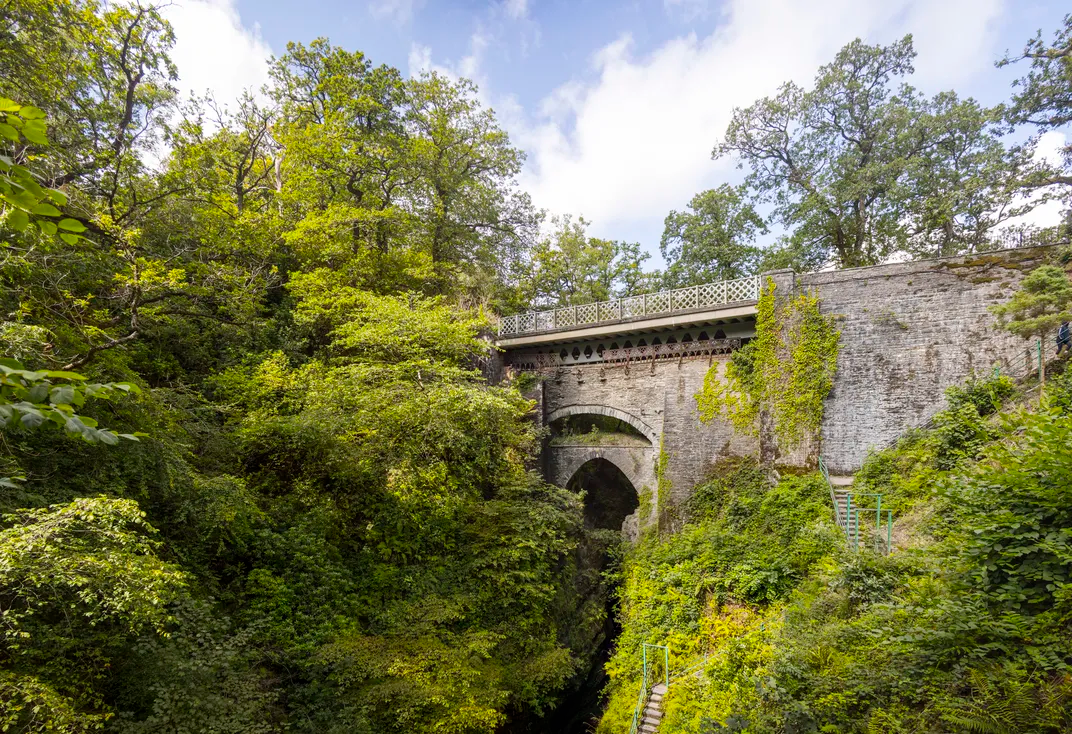
Across Europe, dramatic landscapes and ambitious structures that seemed impossible for humans to create have often been attributed to devils, giants, dragons, saints and other supernatural beings.Here is the legend behind Devil’s Bridge, Aberystwyth, Wales.
The Devil’s Bridge comprises three bridges, one above another, spanning the Mynach Gorge. The lowest is thought to date back to the medieval period, possibly built by monks from nearby Strata Florida Abbey. A second was added in 1753, and the third, an iron bridge, was constructed in 1901. The Mynach Falls drop nearly 300 feet through a narrow ravine (沟壑) before the river Mynach joins the Rheidol.
According to legend, the devil offered to build the bridge in return for the soul of the first living creature to cross it. An old woman fooled him by throwing bread across the bridge and sent her dog after it (as a sacrifice).
The history is less tidy. Michael Freeman, vice president of the Ceredigion Historical Society, says the bridge was known as Pontarfynach, or the Monk’s Bridge, in Welsh. Its association with the devil doesn’t seem to date beyond the early 18th century. The story was not mentioned in print until the early 19th century when English tourists helped publicize it, he says.
“People in the past, who could not understand how seemingly impossible structures were built, ascribed special powers to them, such as the devil, giants, and others,” Freeman says.
Juliette Wood, a folklorist at Cardiff University, says the Devil’s Bridge story is “one of many common legends usually called ‘migratory,’ as it appears in so many places.”
The devil isn’t always as formidable as he sounds. Wood says the “devils” who built these things are usually not frightening at all — they are more like giants, and easy to trick. She points out how easily they are tricked in these stories.
1.1. In Wales, what do we know about the oldest of the three bridges?
A It was constructed in the year 1753.
B It was made of iron in 1901.
C It probably dates from medieval times.
D It was designed by English tourists.
解析:选C。C 细节理解题。文章第二段明确指出,三座桥中最低、也就是最古老的一座“is thought to date back to the medieval period, possibly built by monks”,因此 C“它可能建于中世纪”正确。A 的 1753 年是第二座桥的建造时间;B 的 1901 年铁桥是第三座桥;D 中英国游客是后来帮助传播魔鬼故事的人,并不是设计最古老桥的人。所以选 C。
2.2. According to Michael Freeman, what can we learn?
A A devil constructed the bridge.
B Its name came from a river.
C Welsh monks spread the story.
D The devil part came much later.
解析:选D。D 细节理解题。根据 Michael Freeman 的说法,这座桥与魔鬼的联系“doesn’t seem to date beyond the early 18th century”,而且这个故事直到 19 世纪初才被印出来,并由英国游客帮助传播,因此 D“魔鬼部分出现得晚得多”正确。A是传说内容,不是Freeman的历史结论;文中并未说桥名来自河流,因此B无依据;C 中传播故事的是英国游客,不是威尔士修士。所以选 D。
3.3. What does the underlined word “formidable” probably mean?
A Terrifying.
B Absurd.
C Merciful.
D Intelligent.
解析:选A。A 词义猜测题。画线词formidable出现在“The devil isn’t always as formidable as he sounds.”中,下文紧接着说这些“devils”通常“not frightening at all — they are more like giants, and easy to trick”,说明 formidable 与“吓人的、可怕的”意思接近,因此 A“Terrifying”正确。B“Absurd”荒谬、C“Merciful”仁慈、D“Intelligent”聪明,都不符合后文“不吓人、容易被骗”的语境。所以选 A。
4.4. What is the text mainly about?
A How three stacked bridges were built over time.
B Why strange structures attract supernatural tales.
C How a clever woman tricked the devil once.
D Why Welsh historians study local old bridges.
解析:选B。B 主旨大意题。文章开篇提出欧洲许多看似人力无法完成的壮丽景观和建筑常被归因于魔鬼、巨人等超自然存在,随后以威尔士的 Devil’s Bridge 为例,介绍其传说、历史来源,并引用专家说明人们因无法理解这些结构而赋予它们超自然力量,这类故事还是常见的“migratory”传说。因此全文主旨是 B“为什么奇怪的结构会吸引超自然传说”。A 只涉及三座桥的建造时间,是细节;C 只是传说中的一个小故事;D 文中并没有讨论威尔士历史学家研究当地旧桥的原因。所以选 B。